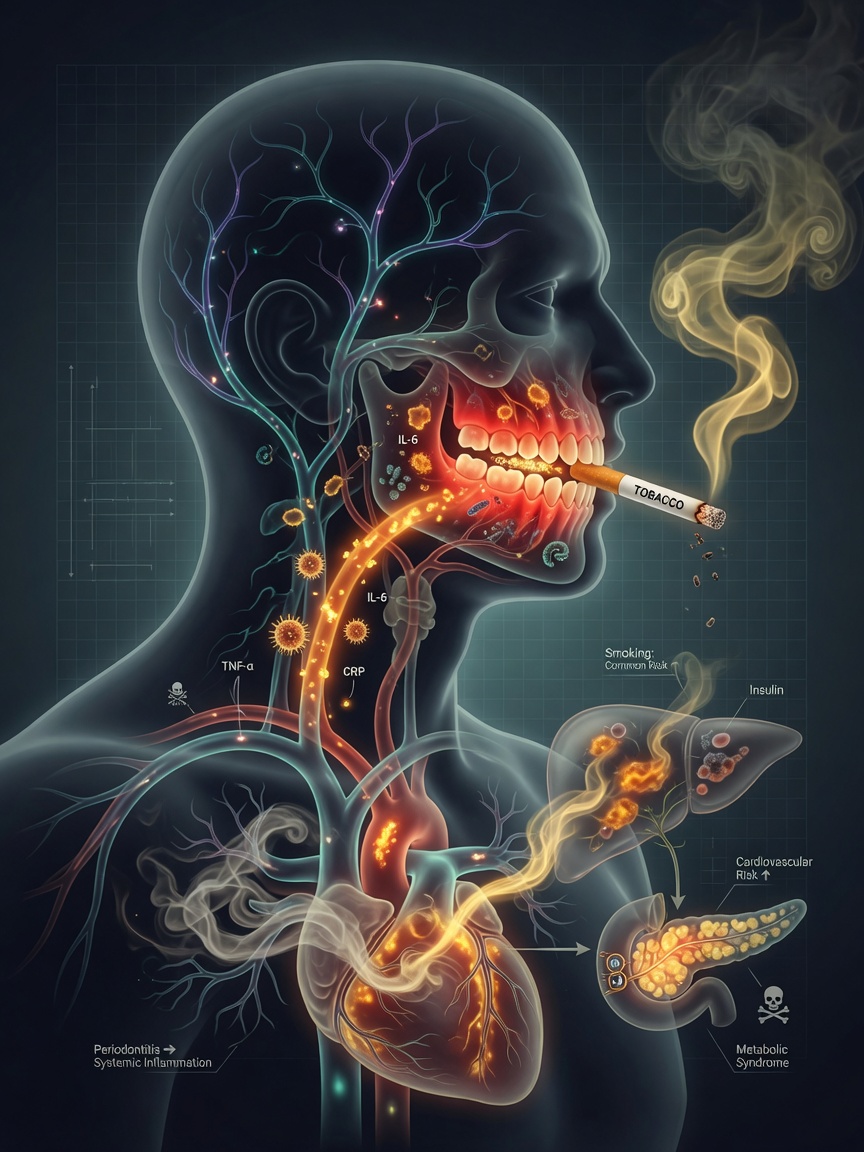
The Link Between Oral Health and Systemic Diseases — How Smoking Becomes a Common Risk Factor
On a Tuesday morning in March 2024, I accompanied my father to his follow-up appointment in the dental department of a tertiary hospital. He had been smoking for over thirty years, with the deepest periodontal pockets measured at 6–7 mm, bleeding upon probing. That same morning, the cardiology follow-up sheet noted fluctuating blood pressure and elevated LDL; the endocrinology department's HbA1c was around 7.2%. Three departments, three sheets of paper, seemingly unrelated. Sitting on the plastic chair flipping through those numbers, it became increasingly clear to me: they share the same "key" — **chronic inflammation in the oral cavity, and the continuous risk escalation driven by cigarettes**.
---
I. The Oral Cavity Is Not an Island: The War Inside Your Mouth Enters Your Bloodstream
Many people dismiss "toothache, bad breath, red gums" as minor local issues, at most thinking about fillings or cleanings. The more striking clinical reality is:
- **Caries and periodontal disease** are the most common oral infections/inflammatory diseases;
- Bacterial plaque and toxins accumulated in periodontal pockets can enter the bloodstream through transient bacteremia during chewing, brushing, or scaling;
- Long-term low-grade inflammation elevates systemic inflammatory markers (such as C-reactive protein-related pathways) and plays along with endothelial dysfunction, insulin resistance, and other "systemic scripts."
National disease control agencies and health education materials across many regions have repeatedly emphasized: Oral diseases share common risk factors with diabetes, cardiovascular and cerebrovascular diseases — smoking, excessive alcohol consumption, high-sugar high-fat high-salt low-fiber diet, mental stress, etc.
World Dental Federation (FDI) and similar organizations have also consolidated consensus: between oral diseases and systemic diseases such as diabetes and cardiovascular disease, there are both shared risk factors and overlapping pathological mechanism clues.
My personal judgment is straightforward:
**Seeing the mouth and the body as separate is one of the most expensive misconceptions of modern times.**
You don't have to believe the absolute statement "periodontitis definitely causes heart attacks," but you must acknowledge: the same set of lifestyle habits and the same inflammatory environment often destroy both the alveolar bone and the vascular wall at the same time.
│
├─ Transient/recurrent bacteremia, toxins and inflammatory mediators entering the blood
│
▼
[Systemic low-grade inflammation / Endothelial stress / Metabolic disorders]
│
├─► Increased risk related to atherosclerosis
└─► Blood sugar harder to stabilize, infections harder to clear
▲
│
[Smoking] ──Simultaneously attacks oral healing + blood vessels + glucose metabolism──┘
---
II. A "Common Risk Factor" Checklist: Why Smoking Ranks First
1. The Checklist Itself Is Not Mysterious
When oral chronic diseases and cardio-cerebral and metabolic chronic diseases are laid on the same table, overlapping items appear almost every time:
| Common Risk Factor | Typical Harm to Oral Health | Typical Harm to Systemic Health |
|---|---|---|
| **Smoking** | Periodontitis risk and severity greatly increased, poor healing, masks bleeding | Endothelial damage, thrombosis tendency, increased heart attack/stroke risk |
| High-sugar high-fat high-salt, low-fiber diet | Caries, periodontal inflammatory environment | Obesity, dyslipidemia, diabetes, cardiovascular disease |
| Long-term high stress, poor sleep | Impaired immunity and repair, bruxism and secondary issues | Blood pressure fluctuations, metabolic disorders |
| Physical inactivity, obesity | Higher baseline inflammation | Insulin resistance, atherosclerosis |
| Poorly controlled diabetes | Accelerated periodontal destruction, uncontrolled infection | Microvascular/macrovascular complications |
| Low socioeconomic status and poor healthcare access | Scaling and maintenance treatment interrupted | Chronic diseases discovered late, poorly managed |
2. Smoking's "Dual Identity"
Smoking is not just an ordinary row in this table — it has layered identities:
- **Common risk factor**: The same cigarette both elevates periodontitis risk and promotes atherosclerosis and multiple chronic diseases.
- **Confounding factor**: Many epidemiological associations between oral and cardiovascular health weaken or even partially "disappear" after strict adjustment for smoking — showing that smoking itself contributes enormously.
- **Disease amplifier**: Once periodontitis or diabetes is present, continued smoking worsens treatment response and speeds up recurrence.
I've seen many people take comfort in "my gums don't bleed much." In smokers, gum blood vessels are constricted and blood supply is poor — bleeding may not be obvious, but destruction proceeds in secret — this is one of the most insidious illusions in the clinic. Periodontal probing, periapical radiographs, or panoramic tomography are far more reliable than "looking in the mirror to see if it's red."
Relative risk magnitudes vary by study, but the direction is highly consistent: smokers have significantly higher periodontitis risk than non-smokers; some data in age-stratified analyses describe tenfold to twentyfold relative risk levels (specific numbers vary with definition, age group, and exposure level, and cannot be taken as individual probabilities). On the cardiovascular side, smoking has long been recognized as a major modifiable risk factor — no need to debate "whether there's a link."
Personal view:
If I could change only one habit to simultaneously "protect teeth + protect heart + protect blood sugar," I would rank quitting smoking ahead of "buying a more expensive toothbrush." A toothbrush is important, but it cannot block the systemic damage nicotine and smoke inflict on microcirculation and immune repair.
---
III. Periodontal and Cardiovascular Health: Inflammation Welds Two Pipelines Together
1. Correlation Does Not Equal "Periodontitis = Heart Disease," but Correlation Is Enough to Change Behavior
The American Heart Association (AHA) and other organizations' scientific statements on periodontal disease and atherosclerotic cardiovascular disease (ASCVD) are continuously updated: periodontal disease is more common in people with poor oral hygiene accompanied by hypertension, obesity, diabetes, smoking, and other cardiovascular risk factors; numerous observational studies show associations between periodontal disease and events such as heart attack, stroke, atrial fibrillation, and heart failure.
At the same time, scientific honesty requires us to state the other side:
- Both share factors such as age, sex, smoking, activity level, body weight, and socioeconomic status — **causal arrows are difficult to nail down with a single observational study**;
- Some large-scale analyses, after adjusting for smoking status, found that the association between tooth loss and cardiovascular events weakened significantly — which actually **strengthens smoking's position as a common risk factor**;
- Whether periodontal treatment can reliably reduce "hard endpoints" like heart attack and stroke remains inconclusive — it cannot be considered a substitute for cardiac stenting.
My position is:
**Don't use "it's not 100% proven yet" as an excuse to keep smoking and ignore periodontal treatment.**
For personal decision-making, shared risk + biologically plausible mechanisms + the fact that treating periodontitis itself improves oral function and quality of life — that's already sufficient grounds for action.
2. Mechanisms: What Doctors Are Talking About
The mainstream hypotheses can be condensed into three points for easy recall:
- **Direct pathway**: Periodontal pathogens (such as Porphyromonas gingivalis, etc.) and their products enter the bloodstream, damage the endothelium, and participate in plaque-related inflammatory environments. Studies have detected overlapping periodontal bacterial traces in atherosclerotic plaques and subgingival plaque (this does not mean "plaques are all grown from oral bacteria," but it demonstrates the pathway exists).
- **Indirect pathway**: Periodontitis maintains systemic low-grade inflammation, with elevated IL-6, TNF-α, CRP, etc., driving the development of atherosclerosis.
- **Common soil**: Smoking, diabetes, dyslipidemia, etc., simultaneously irrigate periodontal pockets and vascular walls.
Around 2023, during that cross-department visit with my father, the cardiologist did not say "fix your teeth first, then you won't need a stent." Instead, he said something more pragmatic: Change the risk factors you can change. Periodontitis counts as one visible inflammatory window. The cigarettes must stop. That sentence was more useful than any scare-tactic copy.
3. Actionable "Heart-Teeth" Joint Defense, Not Anxiety
- Moderate to severe periodontitis + existing ASCVD risk factors: systematic dental treatment + cardiology/general practice management of blood pressure and lipids — **do both simultaneously**.
- Inflammatory markers may briefly fluctuate within 24 hours after scaling and root planing — a common clinical phenomenon; long-term maintenance (every 3–6 months, depending on the case) is more important than "one cleaning and forget about it."
- Smokers who don't report their smoking history or daily cigarette consumption distort periodontal prognosis assessment — that line on the consultation form is not just a formality.
---
IV. Periodontal Disease and Diabetes: A Tight Two-Way Street
If we need to be careful with wording on the cardiovascular side, the bidirectional relationship between type 2 diabetes and periodontitis is clinically very "solid":
- Long-term high blood sugar → impaired leukocyte function, microcirculation, and collagen metabolism → faster periodontal tissue destruction, higher risk of abscesses and implant failure;
- Uncontrolled periodontitis → increased systemic inflammatory load → worsened insulin resistance → HbA1c harder to lower.
Cohort and intervention studies support: after controlling for lifestyle factors such as smoking and BMI, periodontal treatment may still be associated with HbA1c improvement (the magnitude of improvement varies by baseline, treatment quality, and compliance; commonly discussed magnitudes are around a few tenths of a percentage point — no guarantees that "scaling equals diabetes medication").
A Reviewable Timeline (Father's Case, Anonymized)
| Time | What Happened | Numbers/Actions | Bottlenecks |
|---|---|---|---|
| November 2023 | Check-up found elevated HbA1c, initial dental visit | HbA1c ~7.8%; bleeding on probing at most sites; multiple pockets ≥5 mm | Still smoking 15–20 cigarettes/day; thought "rinsing after meals is enough" |
| December 2023 – January 2024 | Staged supragingival scaling + subgingival scaling/root planing; home oral hygiene retraining | Bass brushing technique + water flosser + dental floss; chlorhexidine mouthwash short-term (as prescribed) | 2 days of sensitivity and mild swelling after scaling; smoking slowed healing |
| February 2024 | Tried "smoking a few less" instead of quitting | Pocket depth slightly improved, bleeding reduction limited | **Reduction does not mean proportional risk reduction**; gum color still dark |
| March 2024 | Cross-department follow-up; began serious quit attempt | Blood pressure still elevated; HbA1c dropped to ~7.2% | Irritability during withdrawal, worsening night bruxism, temporary occlusal splint |
| June 2024 | Periodontal maintenance therapy + endocrinology follow-up | Bleeding on probing sites significantly reduced; HbA1c further approaching individual target | Relapsed for 3 days at a gathering; gums felt "tight and swollen" again — relapse signal came fast |
This table is not an advertisement — it's a reminder: Periodontal treatment, blood sugar management, and smoking cessation are three ropes that must be twisted together. Pull on only one, and the net will break again.
5 Things I Recommend Diabetic Patients Default to for Oral Health
- Within **12 months of diabetes diagnosis**, get a formal periodontal evaluation (probing, imaging, plaque control scoring) — don't wait until "teeth are loose before extraction."
- During phases of wildly fluctuating postprandial blood sugar, oral infection symptoms may be amplified — if gum abscesses or sudden tooth elongation sensation occur, prioritize emergency dental care rather than just increasing painkillers.
- When HbA1c is persistently >7% (specific targets vary by individual, follow your endocrinologist's advice), periodontal surgery timing often requires more cautious evaluation.
- Diabetic patients who smoke are at "dual high risk" — scaling intervals can be discussed and shortened, but **the root cause remains cigarettes and blood sugar**.
- Before dental implants or complex restorations, be clear about smoking status and blood sugar control — otherwise you'll spend the money and still face high peri-implantitis risk.
---
V. How Smoking Welds "Mouth-Heart-Blood Sugar" into the Same Accident Scene
Condensing the mechanisms into four plain statements:
- **Microcirculation and oxygen supply**: Nicotine constricts blood vessels, carbon monoxide reduces oxygen-carrying capacity — both gums and heart muscle are "working overtime in hypoxia."
- **Immunity and healing**: Neutrophil function becomes disordered, collagen synthesis is affected — post-scaling attachment recovery, post-surgical wounds, even extraction socket healing are more difficult.
- **Elevated inflammatory baseline**: Smoke-related oxidative stress + chronic periodontal infection = continuously sprinkling pepper on vascular endothelium and insulin signaling pathways.
- **Behavioral bundling**: Smoking often appears packaged with caffeine, staying up late, high-sugar snacks, and prolonged sitting — dietary and stress factors are amplified together.
So I oppose two extremes:
- **Extreme A**: "Since it's all related, just cleaning my teeth will prevent heart attacks." — Over-promising, delays proper cardiovascular treatment.
- **Extreme B**: "Causality isn't proven, so I can keep smoking and let periodontitis slide." — Using scientific uncertainty to excuse addiction.
The executable middle path is:
+ Basic periodontal treatment and maintenance
+ Blood pressure / lipids / blood sugar management
+ Reduced frequency of high-sugar sticky snacks, bedtime cleaning
= Simultaneously reducing probability of oral collapse and systemic chronic disease overlap
---
VI. My Real Judgment and Priority Order Outside the Clinic
If a reader has only 30 seconds, here is my priority order (for those with "smoking history + gum problems + chronic disease risk"):
- **Today**: Count your daily cigarette consumption and note it in your phone memo; look in the mirror at gum color, recession, and suppuration; try interdental cleaning with floss or a water flosser once.
- **This week**: Schedule a periodontal probing appointment (don't just say "cleaning" — get pocket depth and attachment loss assessed); save photos of your most recent blood pressure, lipids, fasting blood glucose or HbA1c in one folder.
- **Within two weeks**: Start the cessation preparation period — choose a quit date, clean out ashtrays, inform family, assess whether nicotine replacement or outpatient medication is needed (as prescribed).
- **1–3 months**: Complete the basic phase of the scaling/root planing plan; check gum bleeding and pocket depth trends after one month smoke-free; follow up with endocrinology/cardiology as scheduled.
- **Long-term**: Periodontal maintenance every 3–6 months; no "social smoking" relapses; blood sugar and blood pressure numbers deserve to be taken as seriously as periodontal charts.
Let me emphasize my personal view once more:
The most powerful public lever connecting oral health and systemic disease is often not some magical mouthwash, but removing smoking from your life, and then managing periodontitis as a chronic condition that requires maintenance. The heart and blood sugar will benefit — not superstition, but the same blood vessels and the same immune system getting a lighter load.
---
VII. 7-Day Action Checklist (Ready to Check Off)
| Day | Action | Completion Standard |
|---|---|---|
| Day 1 | Record cigarette count + oral selfie (gums, tongue coating) | Have numbers and photos |
| Day 2 | Bass brushing twice, each ≥2 minutes; add floss/water flosser once | No persistent food impaction between teeth |
| Day 3 | List questions about current BP/lipid/diabetes medications and smoking relationship | Can ask doctor at follow-up |
| Day 4 | Online or phone appointment for periodontal evaluation | Have a specific date |
| Day 5 | Clean up one fixed smoking spot (balcony table, car ashtray) | Physical environment changed |
| Day 6 | Measure blood pressure once; if you have a glucometer, measure fasting or postprandial | Numbers written into same note |
| Day 7 | Set a quit date (recommend within 1–2 weeks) and tell one person to hold you accountable | Date written on calendar |
---
VIII. Final Words: The Endpoint of an Article About Connections Is Decision, Not Fear
My father eventually quit smoking for over half a year. Periodontal maintenance continues, HbA1c and blood pressure didn't return to zero overnight, but bleeding on probing decreased, that long-term metallic taste in his mouth faded, and morning dryness wasn't as severe. He once said: "I used to think teeth were teeth and blood pressure was blood pressure. Now I realize cigarettes were threading through everything in between."
That sentence is more accurate than any clickbait headline.
The link between oral health and systemic diseases is not about panicking over every bleeding gum, but about seeing:
- Periodontal pockets and arterial walls share an inflammatory language;
- Diabetes and periodontitis pile burdens on each other;
- **Smoking sits at the center, fueling both sides simultaneously.**
Remove this common risk factor, complete the necessary medical consultations, and finish the scaling and maintenance — this is the highest-information-density, most cost-effective systemic health strategy I have ever seen.
---
*This article is for health education purposes, combining public medical consensus and individual case observations. It cannot replace a licensed physician's in-person diagnosis and individualized treatment plan. If you experience chest pain, difficulty breathing, severe toothache with fever, or drastic blood glucose fluctuations, please seek emergency or specialist care promptly.*